Showing posts with label southern africa. Show all posts

Sunday, December 05, 2010

Magical kingdom in the sky

This photo, which I took in Lesotho two years ago, came to mind as I perused submissions to National Geographic's photography contest.  Lesotho, strangely embedded within South Africa, is the only country entirely above 1000 meters.  It has rightly been dubbed "the magical kingdom in the sky."  And for an exhausted traveler leaving tumultuous South Africa, it was magical.


(Click for larger size. Oh, all rights reserved.)

We encountered these Basotho shepherds on Hodgken's Peak, also taking in the 360-degree view.  At 3256 meters, I struggled for air, having just arrived from Durban and the Indian Ocean coast. 

It's been over two years, but I think frequently of that 56-day trek through South Africa, Lesotho, Namibia, Botswana, Zimbabwe, and Zambia (whew!).  It was a fantasy, traveling as a modern nomad with a map, a pack, and my hitchhiker's thumb.  From my current perch in Michigan - with legal textbooks now spread across my desk - it might feel like another existence.  But it doesn't.  I am still basically the same person I was two years ago.  As we grow older, it seems, we grow slower.

Tuesday, October 21, 2008

Knifepoint

[Events from July 11, 2008, Durban, South Africa.]

It would have been easier to cooperate if they hadn’t jumped me from behind. The mugging was well-coordinated, honed through experience and executed with expert speed. I didn’t realize what was happening until it was nearly over. One pulled my satchel-bag over my head, two others checked my pockets. The one on my left moved quickly - too quickly – taking my wallet but missing my phone. The one on my right side checked for a money belt - raising my shirt to my belly button - while waving a knife across my exposed stomach. It happened in silence. Forty people bustling around an intersection, cars honking, and in my mind, the whole world went mute.

What I remember… The knife glistening in the afternoon sun. 1:30 pm. One fucking thirty.

Hands touching me. Three muggers, a pair each. There were hands in my front pockets, hands in my back pockets, hands not mine. The sense of intimate transgression, of nothing sacred.

10-15 seconds? I saw no faces, but they looked about 30 years old.

It’s depressing to think that I wasn’t the first and I won’t be the last.

As I felt the bag coming over my head, I instinctively slapped it down and locked it against my side. I was expecting to see a gang of street-kids – the sort I had heard about and would later meet (with no unfortunate consequences) in Bloomfontein. So I held on... until I saw the knife – not some dinky little switchblade that could disappear up a sleeve (as I had always imagined), but a hefty butcher’s knife, ten inches long and two inches thick at the base. Then a hand from the other direction pushed my head sideways, knocking off my glasses. Everything blurred.

Sam had just one mugger, a "nice mugger." We joked about that later – or at least I did. The nice mugger requested Sam's wallet, took out the cash, and handed the rest back. No weapon. If they didn’t take Sam’s credit card, maybe they dropped mine. A few minutes later, I started to return to the street corner, the scene of the crime. I was stopped by an old woman sitting with a basket of fruit. “Do not go back,” she advised. “They will only take your watch.” I took it she knew.

People looked at us, sorrowfully. Pitifully? No, I imagined, shamefully. We passed a mobile barbershop, a tent erected on the sidewalk twenty feet away. The men inside stared at their feet and shook their heads. Did everyone know? Did everyone feel sorry about screwed-up-South Africa, as one person commiserated? Wherever we walked the next hour, I imagined everyone had witnessed our distress, our embarrassment – look, it’s the two white guys with their empty pockets.

Afterward I sought solace in a used book store. I insisted on it and Sam indulged me. I bought (with Sam’s card) Achmat Dangor’s Bitter Fruit, a book I had eyed at previous bookstores but deemed beyond my budget. Not anymore. With no money, relative costs seemed negligible.

I lost a camera (the fools… the peculiar battery expired within hours), a day’s worth of pictures, about forty bucks, and both my credit and ATM cards (stupid, Eli, stupid). I kept my driver’s license, safely hidden in my shoe along with a slip of paper detailing the proper numbers to call in case of credit card emergency. Before departure, I joked with friends that getting mugged was inevitable in South Africa. I would be prepared. As I dialed the numbers, I vaguely felt pride.

It didn’t last. On the minibus back to the hostel, I wanted to cry.

I’ve sat on this write-up since I scribbled it that night of July 11 at the Happy Hippo hostel in Durban. I didn’t mention it to family or most friends for the next six weeks; I didn’t want them to worry. And I didn’t want to be seen as a victim. After one day, I was already sick of feeling sorry for myself. Less articulated at the time, I also didn’t want to acknowledge how the experience might affect me. I had assumed a stoic attitude toward misfortunes on the road and was intent on practicing that stoicism – lest the vicissitudes of third-world travel cost me my sanity.

Beyond that, I always knew muggings happened before one happened to me. Why should this personal misfortune change anything? Be reasonable. I told myself repeatedly (in an effort to believe it?) that I’d rather be mugged again than live in fear. Everything would stay normal. Sam spent our second day in Durban at the hostel; I ventured back into the city. My patterns changed anyway. I started looking over my shoulder. I removed my credit cards from my wallet when walking home through darkened streets. For many weeks afterward, I quaked when two people, particularly two black men, passed me on either side. I expected the worst.

I think I'm over it now, or the worst of it. I responded initially with sadness (desperate people do desperate things), then with anger (these gangs, professional thieves, terrorizing their cities in the daylight!), and with fear (he had a knife!). Yet the desire for vengeance dissipates with time, while (as I hope) the invincibility of youth abides. Mugged? Whatever. Been there, done that.

When people learn that I work for a criminal justice NGO or taught math to prisoners at a max-security facility, they smugly assert that a conservative is just a liberal who’s been mugged. “You wait… If you ever get mugged, it’ll change your mind.” I have and it didn’t.

Saturday, September 27, 2008

Murphy was an African

If there's one way how Southern Africa affected me, it's this: I now expect things to go wrong. In Maryland, Rhode Island, New York, etc., I'd become used to a smooth punctual life. But while traveling, I was lucky if the public bus wasn't full or late or smelly or even broken-down. I started reviewing my notes from the summer, and came across this snippet from my first day, the NYC-London flight, when the airline attendant placed a meat lasagna dish on my tray.

"Sorry ma'am, I ordered a vegetarian meal."

"Sir, we do not provide vegetarian meals."

"At all?"

"At all." She turned to walk down the aisle.

"Then how could I have signed up for one when purchasing my ticket?"

"Sir, meal requests do not transfer from discount websites."

"Excuse me?" [Discount websites? Why not simply "other websites"? Was she intentionally demeaning, or did she deduce that because her airline had no veggie option, I had purchased my ticket elsewhere?]

"You cannot assume the airline is informed of those particulars."

As if it were my fault.

I let loose. "That's not the problem; the problem is that vegetarians aren't some marginal fringe group of radicals. It's a popular widespread choice, including clearly among your clientel."

She seemed to concede my point. Then conceding hers, I ate a lettuce-tomato salad for dinner.

Two months of travel later, I faced a similar problem on the flight home. I shrugged.

Wednesday, September 24, 2008

Home sweet home

CNN's Campbell Brown's great "free Sarah Palin" segment (YouTube, text), highlighting the McCain campaign's sexist treatment of its very own candidate, has finally inspired me resume this blog. But I'm going to resist wading into presidential politics in favor of a brief update.


I now live in Cincinnati, Ohio, working for an inspiring prison reform NGO as a "mental health advocate" (exact job description in process), on an effort to improve "discharge planning" for soon-to-be-released mentally ill prisoners. It'll help them prepare for the return home. I've spent the last few weeks trying to understand the mental health and criminal justice "systems."

I returned in late August from travels in South Africa, Lesotho, Namibia, Botswana, Zimbabwe, and Zambia. I began in Cape Town to visit my brother at the Treatment Action Campaign, an impressive HIV/AIDS activist organization. I backpacked overland to Zambia via public buses, minibuses, rikkis, taxis, and hitchhikes. I started days not knowing what city I'd land in, much less where I'd sleep. I spent some nights under the stars. I lived out of a backpack with only a few pairs of clothing and stayed constantly on the move, sleeping in 29 different places over 56 days.

I am thinking about revamping this blog, including its name. Suggestions welcome.

Sunday, July 27, 2008

The dunes

I haven't updated in a while. I've been busy and cheap. In another month, I'll update with stories from South Africa. Anyway, this week I'll be in Sossusvlei, Namibia. Be jealous. :)

Tuesday, July 22, 2008

On the South African road

It's been just over three weeks in South Africa. My travel buddy Sam and I started in Cape Town, then moved along the southern coast, eventually reaching Durban, then shot north to the Drakensburg Mountains and Lesotho, heading back east via Bloemfontein (SA's neglected third capital, after Pretoria and Cape Town) en route to Cape Town. We have slept in innumerable places: in hostels, on buses, in candle-lit villages, at an Anglican missionary center, and once, on the tile floor of a bus station (we had alas, ran out of money, though we're okay now).

The journey was haphazard and accidental, planned last-minute on our feet. We chose destinations more by the availability and timing of buses than by any pre-planned itinerary.

The bus had a “cabin attendant,” someone to take tickets and inform passengers that the coach had two exits and that smoking was strictly prohibited. The attendant at first made announcements in Xhosa and English, but the English disappeared as the night wore on. The buses are either double-deckers or seat five people per row, despite being just as wide as US buses. At first I thought that five-across was unconscionable. The ridiculous squeeze into decades-only minibuses gave me perspective. Just like the US, few whites take buses. Sam and I were the only ones. I had some fun asking the little kids – who always seemed to stare – where my skin color had gone.

Many international travelers take the "Baz Bus," an expensive comfortable little bus that picks up and drops off from hostels. Sam and I went for the more "authentic" public bus experience. We ended up meeting several locals, one of whom gave me a tour of Lesotho or offering crucial advice or favors. One, a baSotho medical student at the University of the Free State in Bloemfontein, ended up hanging out with us for the day. I couldn't pronounce her name (Mpoi) quite right, and she couldn't quite pronounce mine, but we had a wonderful time regardless.

I love observing South Africa's distinctive brand of road signs. Some beg drivers to “SLOW DOWN PLEASE.” Others remind drivers: “DON’T FOOL YOURSELF / SPEED KILLS.”

Other tidbits: In the US, beggars are beggars, clearly recognizable, usually sitting and jiggling a cup. It’s not so clear in South Africa. Any passing person is a potential beggar. “Got a few coins, man?” someone might ask me on his way to work. But the most disconcerting thing about public begging in South Africa is that much of it is done by children even below the age of 10, sometimes standing on the dotted lines of the streets - the small spaces that separate the lanes.

We spent a few days in Cintsa on the “wild coast” just north of East London. We strolled the beach, picking up shells from the Indian Ocean beach. We cliff-jumped, spoke with Xhosa people in their village, and observed the “white development” along the coast line. “Black Africans don’t build homes like that,” said our guide Denver, a cool 25 year-old white native of the area. “The whites are always trying to out-do each other – more porches and balconies and fences. The Xhosa distinguish themselves simply by painting their huts different colors.”

We spent an hour or two with a Xhosa matron named Mama Tofu, 88 years old, once active int he anti-apartheid struggle. She seemed to want us to declare, “that’s backward!” and took every opportunity to describe gender roles: men shepherd the animals, women mash corn, bake mud for building homes, carry babies, etc. If a woman has sex before marriage, she is “damaged.” She said nothing about men’s “damage.” I asked whether her whether times had changed, whether young Xhosa people agree. Well, if they don’t agree, they don’t know what’s best for them.

My guidebook says that the legal age of consent is 18 for straight sex and 19 for gay sex.

Sam was a solid travel buddy, confident what he liked and disliked. When we went cliff jumping, I leapt off the higher cliff. Sam declined. “If all your friends jumped off a cliff, would you?”

We took the ferry across the river that separates two former racial “homelands” under the apartheid regime - Ciskei (formerly whites only) and Transkei (formerly blacks only, and Mandela's home). The contrast in housing development and quality of roads was obvious.

On the coast, the views is beyond gorgeous. The sun sets to the northwest, not to the south, as elsewhere in this hemisphere. And the big dipper and north star are absent from the night sky.

Sam left a few days ago. I have no idea what's next. The plan is to arrive at Victoria Falls in Zambia by about August 6, but that's still two weeks away. I think I may wander through Namibia or Botswana on the way up - best to save politically tumultous Zimbabwe for a future visit.

Apologies for the lack of photos. The internet cafes aren’t fast enough to upload them.

Saturday, July 05, 2008

Tourist central

I went out last night to Long Street in Cape Town, the bar district, I guess you'd say. Sam and I had thought about celebrating U.S. Independence Day by grilling something and eating coleslaw and freedom fries. But with limited cooking options, Hannan and I opted instead to meet up with a few "internationals" we'd met - Brits, Australians, and Americans working for local NGOS. They wanted to eat at a restaurant called "Mama Africa." Not very American, we joked.

Except... eating at a restaurant called "Mama Africa" is totally American.

Rest assured that the soulless debachery of the bar scene seems steady around the world.

Friday, July 04, 2008

Across the Atlantic

Greetings from Cape Town! My afternoon plans fizzled when we (Sam and I) discovered we need to book a day in advance to visit the Parliament. So here I am at an internet cafe. I've been craving the internet all week. In the states, I used to refresh the news websites obsessively.

I had a ten-hour layover in London on the way to Cape Town and raced around the city: Shakespeare's Globe Theater, St. Paul's Cathedral, Big Ben, the Millenium Bridge, the Tower Bridge, Clink Prison (medieval torture chambers), Whitehall, 10 Downing Street, Buckingham Palace, and Westminster Abbey. I met up with my friend Jen, visiting from Syracuse. For the Abbey, we arrived after the tourist viewing hours and I had to pretend to be a Christian to get inside. I'll have less luck pretending to be a native in South Africa. I bought a one-day pass on the London Underground, so I could jump on and off the tube and the double-decker buses.

Cape Town. I've seen a ton, often with Sam or my brother Hannan who's working here for a HIV activist organization that's currently helping refugees who have fled the recent xenophobic violence against people from other African nations. One evening this week, I went to a refugee housing center to help people register for assylum passes. But there was confusion at the gate and though we spoke to a few very upset refugees (no food! poor sanitation!), we were denied entry. Mostly, though, I've been a tourist. Sam and I walked around the City Bowl town center, saw the distinctive archetecture of the Malay Bo-Kapp area, visited the Castle of Good Hope (built between 1666 and 1679), and spent time in the Company Gardens, a beautiful city park that was once a vegetable patch for the Dutch East India Company. A statue of Cecil Rhodes stands at the center of the gardens above the quotation, "Your hinterlands are there" - which is weird. North American squirrels, apparently brought by Rhodes, scamper through the park.

Later we walked through small Victorian Simonstown to see the penguins at Boulder Beach. Though the exotic-looking postcards said "AFRICAN PENGUINS!," the sailing ships at Simonstown made the place look like Martha's Vineyard. It's also the base of the South African Navy. What else? Sam and I saw the rock art exhibit at the South African Museum and stopped by the Irma Stern Art Museum. We saw the stunning national botanical gardens at Kirstenbosch (where in addition to the entry fee, we had to pay an additional two rands, or 25 cents, for a one page pamphlet - very nutty). The Kirstenbosch gardens, located at the base of Table Mountain, features 9000 plant species from across South Africa - lots funky trees I had never seen before. We smelled the smells and tasted the fruits (no one was looking) and sat down under a gorgeous tree - until, at least, a bird pooped on my head. I jumped up so quickly that I cluncked my head on a branch. I suppose that's funny - in hindsight - or will be once the bump fades away.

I spent an evening at a youth detention facility in Wynland, south of Cape Town, through an organization here that works with youth in South African prisons. We played a few games with the boys, aged 13-16, then did a few word-finds and had them form sentences. English literacy is crucial for education here and these boys are far behind. I had the sense that without some serious intervention, they'll grow up to become real punks, terrorizing the cities. Either that, or boys will be boys, pantsing each other and getting in play-fights to protect their egos.

We've traveled by bus, train, cab, and rikki (sorta like group cabs that cram in as many people as possible). We've so far purchased first-class tickets on the train - they're only fifty cents more, a little more comfortable, and supposedly safer. The security guards hang out on the first-class cars, sometimes as many as six guards at a time, sometimes being louder than the passengers. The security walk through the first-class cars, kicking out people who don't have the right ticket. But they never asked to see ours - we're so clearly tourists, it's disconcerting.

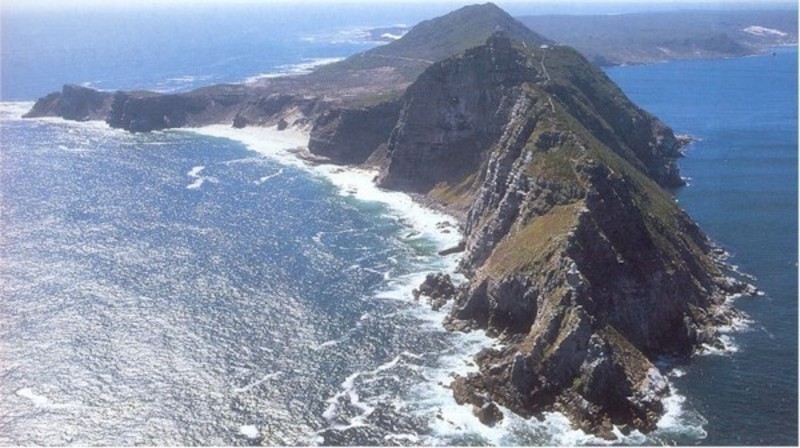
Yesterday Sam and I hiked to the lighthouse at Cape Point and the Cape of Good Hope. It was stunning, even though it later rained. The wind was intense. I spent the forty-minute rikki ride discussing the "black consciousness movement" in South Africa with the (black) driver. Black empowerment is a very good idea, he said, but because of apartheid, not enough blacks are educated for black empowerment to succeed. In another generation, maybe. I told him about affirmative action in the US. Anyway, here's a photo of Cape Point that I obviously didn't take.

It seems like an Afrikaans thing to say "yea" at the end of sentences, e.g., "This blog post is really boring and way too long, yea." I'm not sure when I'll write again, but hopefully not soon. :)

Sunday, June 15, 2008

Prepping for South Africa

I have a booklist. It's long and won't be finished before I leave twelve days from now. I've read J.M. Coetzee's Disgrace, Waiting for the Barbarians, and Elizabeth Costello. I've picked up Nadine Gordimer's July's People (and having trouble getting into it) and Achmat Dangor's Bitter Fruit. I'm working through Nelson Mandela's Long Walk to Freedom, and obviously I'm reading the news. If you have suggestions about what I should read or where I should go, let's talk.

Below is a passage from Mandela's autobiography (p. 83). Maybe because we tend to process the world through stories, people sometimes recount a single epiphany or moment when they try to explain their passions. In fact, we desire it; we want an aha! moment, as if there were some striking event and not a general observation of society [as Mandela says, "a thousand indignities, a thousand unremembered moments"] that lead activists to their rabble-rousing. Mandela breaks the trend.

I cannot pinpoint a moment when I became politicized, when I knew that I would spend my life in the liberation struggle. To be an African in South Africa means that one is politicized from the moment of one's birth, whether one acknowledges it or not. An African child is born in an Africans Only hospital, taken home in an Africans Only bus, lives in an Africans Only area, and attends Africans Only schools, if he attends schools at all.

When he grows up, he can hold Africans Only jobs, rent a house in Africans Only townships, ride Africans Only trains, and be stopped at any time of the day or night and be ordered to produce a pass, failing which he will be arrested and thrown in jail. His life is circumscribed by racist laws and regulations that cripple his growth, dim his potential, and stunt his life. This was the reality, and one could deal with it in a myriad of ways.

I had no epiphany, no singular revelation, no moment of truth, but a steady accumulation of a thousand slights, a thousand indignities, a thousand unremembered moments, produced in me an anger, a rebelliousness, a desire to fight the system that imprisoned my people. There was no particular day on which I said, From henceforth I will devote myself to the liberation of my people; instead, I simply found myself doing so, and could not do otherwise.

Saturday, June 07, 2008

To Southern Africa!

When you're as stingy as I am, buying an international plane ticket can be an emotional rollercoaster. While I delayed one last time, weighing departure dates, the price jumped $150. Damn. I proceeded to bash my head into a wall - okay, only figuratively - painfully cognizant of my penchant for deliberation and indecision, this great moral failing. Then, as I began the check-out for the more expensive flight, suddenly (huh?!) a new price appeared, $150 cheaper than the original fare. "Limited offer! Book now!" it told me in flashing red. I entered my credit card number as fast as I could. I don't think I will never understand this industry. I suspect I'm not alone.

So, off I go! I leave NYC on Friday evening, June 27, arrive in London on Saturday morning for a 10-hour day-time layover (yay! accidental trip to London!) and arrive in Cape Town, South Africa, early Sunday morning. For the return flight, I leave Lusaka, Zambia, at 2:30 am on Saturday, August 23 and arrive in NYC late that night. Altogether, two months in Southern Africa.

I suppose I should answer a few questions. Why this trip? Why South Africa and Zambia? I have a practical reply and a deeper one. Practicalities first: The timing worked out beautifully. I leave my post at the bioethics center on June 20 and don't start my new job until September 1 (more about that later). I'm excited to visit Hannah, a Peace Corps volunteer in a rural village in northern Zambia. My brother Hannan is spending his summer in Cape Town working for an HIV advocacy organization - and I want to see him in this new setting outside familial patterns. And finally, after two years in a research job, a computer job, I'm seeking adventure and release. I want to interact with people from radically different backgrounds. After reading so much about climate change and disease pandemics, I want experience this world without borders. And I want to hike a few mountains. (And, importantly, I've saved a few dollars these past two years.)


I haven't fully developed the deeper reason, but it's connected to race and worldview. The history of this country and the history of race - even as an concept - are intertwined. It begins at Jamestown and continues through the 3/5ths compromise, the Civil War, Jim Crow, MLK, Malcolm X, and Barack Obama. Its legacy is apparent: Blacks have lower life expectancy, lower educational achievement, higher infant mortality, and higher incarceration rates. The social epidemic of incarceration - the target of my new work - is rooted in institutional racism, in the punishment of the poor by the powerful under the guise of justice. Somehow I hope that traveling in South Africa and the former British colonial project of Zambia will help me think about race and race relations, and maybe about my place in the world as a Westerner. I'm excited about being in a place where I can say the charged phrase "white supremacy" without being labeled a leftist - just a realist.

The people in prison are excited about my trip. One, a young black man who's lived his whole life in either Albany or prison, told me, "Africa is beautiful, and I'm not just saying that because I'm African." For whites and blacks alike, Africa holds a vaunted place in our consciousness. It's the dark continent; it's "Africa" - nevermind the 46 countries, the 2,000 languages, or the 3,000 ethnic groups. This homogenization of the continent is silly and maybe noxious. Yet everyone does it: whites for the romanticism, blacks because the memory is muddled. For the black prisoner in a rural upstate New York facility, unsure of where his ancestors were captured but feeling just as enslaved as they were, the whole continent feels like home. And not just home, but homeland.

I'm off on this adventure in t-minus 20 days.

Pictured: Flag of Zambia & Table Mountain, Cape Town.